
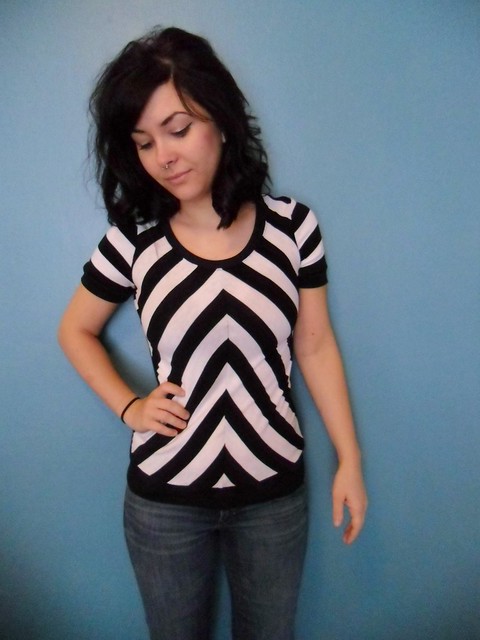
So you wanna sew some knits, huh? Maybe you picked up the Renfrew pattern and haven’t worked up the courage to slice into the pattern tissue yet. Or maybe you’ve been romanced & wooed by all the amazing printed knit fabrics out there. Or maybe you’re just ready for a new challenge that doesn’t involve zippers! Whatever you reason, it’s time to talk knits. Get a coffee and get comfy, this is gonna be a long ‘un.
First off, let me say something very important.
Knits are not scary or super difficult to work with!
I don’t know who is responsible for freaking out millions of sewers to be afraid of knit fabrics, but I wish I did know so I could stick some needles in his (or her!) face. Knit fabrics are actually MUCH easier to work with than a basic woven fabric. Yes, you have to pay special attention to the grainline, but aren’t you doing that anyway with your other sewing projects? 😉 Yes, knits do curl up – but they don’t unravel! Yes, you have to use a special stitch & needle to keep your seams from getting too wavy and/or snapping – but what’s so scary about that?
Here is what is so awesome about knits. I made you a list.
– Don’t wanna hem? Don’t hem! That shit ain’t going nowhere.
– No tedious fitting! Cut your size correct size based on the pattern measurements and let the stretch of the knit do all the work handling those sexy curves you were blessed with.
– No zippers, buttonholes, or closures in general! Pull that shit over your head and get on with your life!
– Finding the grainline is easy – just follow the direction of the greatest amount of stretch.
– Knits are great for using teeny tiny scraps – you can piece the hell out of them (call the seams a ~design feature~) and use them for things like side panels, cuffs and collars, contrasting yokes, colorblocking, insets, creating stripes, pockets, etc. As long as you are paying attention to that grainline, you are pretty much limitless with what you can make!
– You are not limited to *only* using knit yardage to make tshirts – use your pattern to resize a large shirt! Add zippers and hoods or just play with the colors to jazz it up!
– While you don’t need a serger to sew knits, it’s your bestest excuse for buying one 🙂
Now that I’ve gotten you all excited about your new life with knits, let’s talk about those stitches.
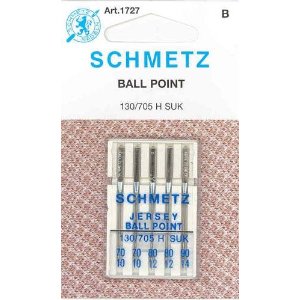
Whether or not you plan on using a serger to sew up knits, you will want to keep a pack of Ballpoint Needles on hand. These are perfect for knits because the tip is slightly rounded, which means they push between the loops of the fabric, rather than pierce little holes to make their way through – this is bad for knits!
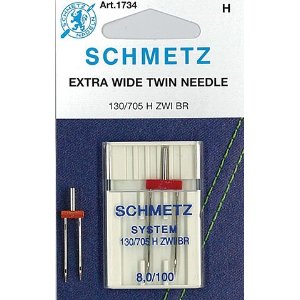
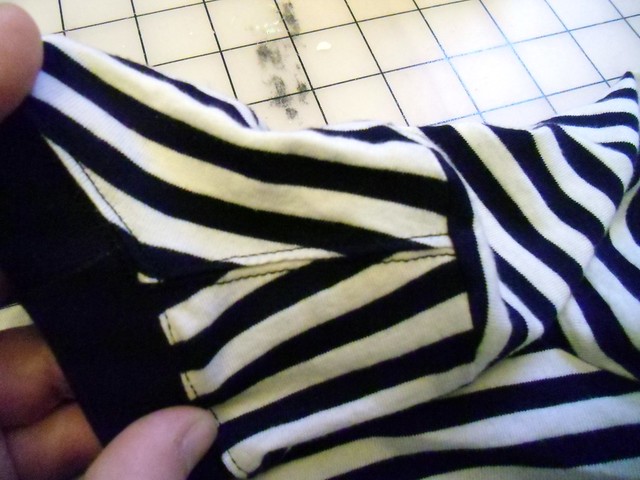
You may also want a twin needle for topstitching – especially if you don’t have a coverstitch machine (Does anyone here have a coverstitch machine? Can I borrow it?). Twin needles are awesome because they will do a perfect row of double stitching on top, and a neat little zig-zag on the bottom. You can get these in all sizes, weights – including ballpoint! – and stitch widths. I use them in place of the zig zag for my top stitching, as I think it looks a little more professional. Keep in mind these are for topstitching only; the stitches they produce are not strong enough to handle seams. You do need two spools of thread to use a double needle; wind some thread onto a bobbin if you don’t have a second spool on hand.
Special stitches are used to construct knits (assuming you aren’t using a serger – if you are, high five!) – you want the stitch to stretch with the fabric, or else you’re going to hear a lot of popping when you pull on your new tshirt. A straight stitch won’t do. And by “special stitches,” I am referring to the good ol’ zig zag stitch. If you want to make your seams a little more sturdy, adjust the zig zag width to be slightly more narrow – but not too narrow, or you’ll make the stitch too dense to actually stretch. Play around with a few scraps of your fabric and see what works best for you.
If your machine is computerized and has the ability to end a stitch in the “needle-down” position, go ahead and engage that – it it helpful for stretching as you sew, without risking pulling everything off the sewing machine. If your machine doesn’t have this feature, just turn the handwheel until the needle is down before you start pulling on your fabric.
If you have a walking foot or dual feed, these are also very nice for keeping the knits from getting too ripply. If you don’t have anything like that, no worries! You can still sew up some pretty knits 🙂

Knit Tips!
When sewing with woven (aka non-stretchy) fabrics, you can kind of fudge the grainlines. It’s not ideal, but the garment will still work as long as you’re not trading bias for straight. With that being said, this does NOT work with knits! It is important to place your pattern on the fabric according to the stretch direction (if you’re not sewing up a 4-way stretch jersey or whatever), otherwise you may not be able to get that shirt over your head.
You want your stretch to run horizontally across the body, not vertical. For neck/sleeve bands, the stretch needs to run the length of the band. I know this sounds really “Well no shit, Sherlock” but you’d be amazed at how many failed knit projects I chucked in the trash due to not figuring out where stretch was necessary. Learn from my mistakes.
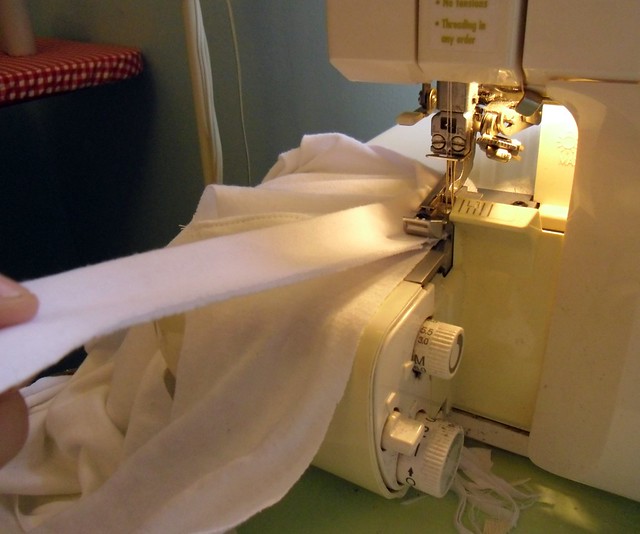
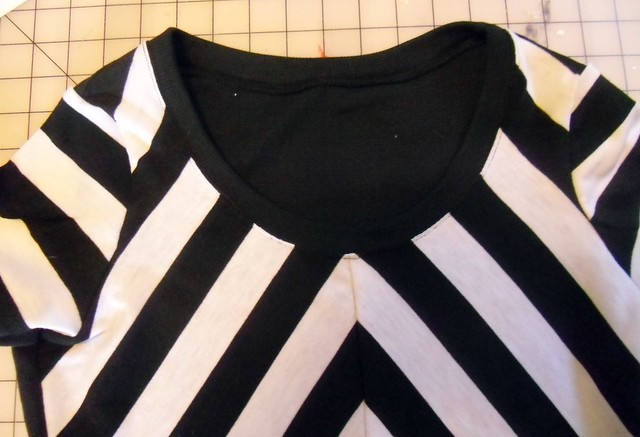
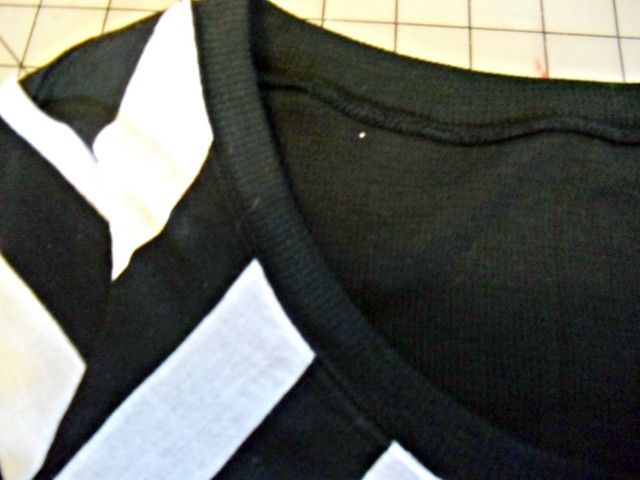
Using the stretch to your advantage is the easiest way to get your knit garments looking supa fly. I am a big fan of foregoing an actual hem on my knits and just making little neck and arm and hem bands to keep everything nice & clean. However, these can really make or break a garment – especially if they end up too loose & floppy when sewn in. The bands need to be a bit shorter than the edge that they are being sewn onto, especially when dealing with necklines & arms. This allows the band to curve nicely and lie flat, without the use of additional stitches to hold it down. If you are sewing up your Renfrew top with something more stretchy than a stable knit, you will want to cut your neckband pieces down an inch or so to take advantage of that nice stretch. When you sew up your pattern, carefully stretch the band to fit – you should just be able to pull gently. It helps to sew with the band on top, so you can control how much you pull.
If you do want to make a hem on your knit that doesn’t involve bands, you can do a nice basic hem using your twin needles. Patty’s Knit 101 post has a lot of great info for this!
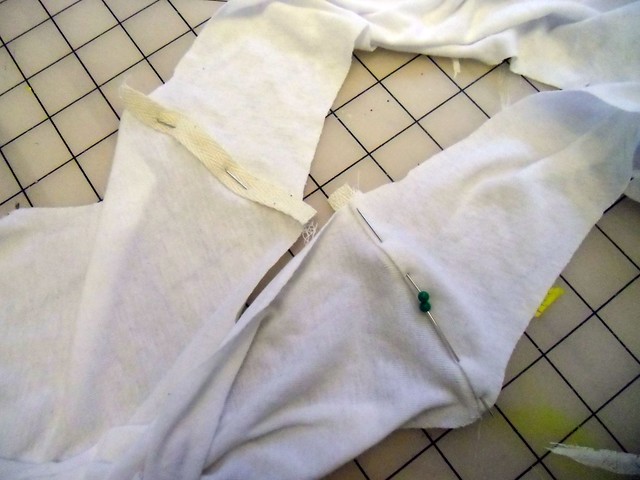
Make sure you stabilize your shoulders – otherwise you will risk stretching them out. A little piece of twill tape or clear elastic is perfect for this. I like to pin mine to the back, centered on the seam, and then top stitch with a double needle. Quick and gets the point across!
PROTIP: Knits look wavy when they are laying flat on a table. This does not mean you failed at sewing. Nine times out of ten, when you put the garment on, the fabric will stretch to accommodate and smooth itself out. Don’t stress unnecessarily over a wavy seam!
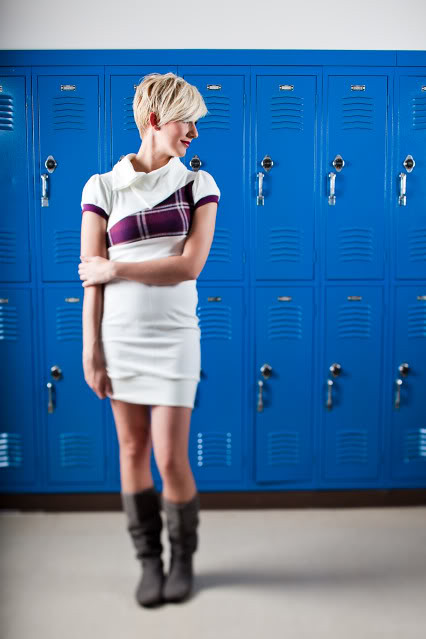
I think that about covers the basics – really, the best way to learn is to just jump in & play around with fabrics & stitches! Try starting out with something really basic & easy – the Renfrew is a great, hand-holding pattern. You could even use it to resize a larger tshirt, which will help you get more comfortable with stretchier fabrics & that zig zag stitch. Don’t worry if your first few attempts leave a little to be desired – it takes practice!
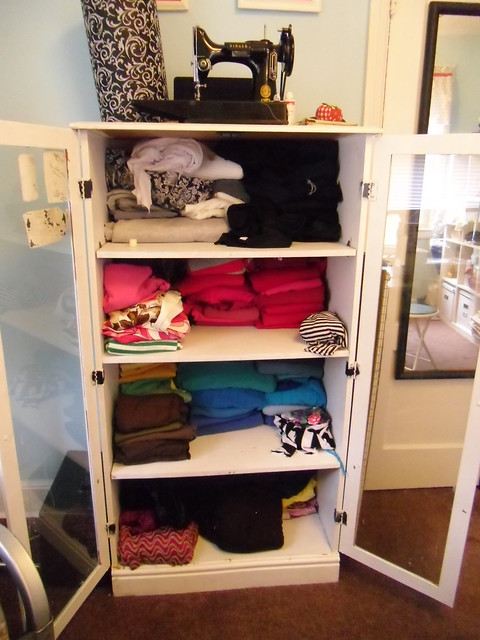
A giant stash of knit fabrics to play with doesn’t hurt either 🙂
I am by no means a professional, but I’ve definitely sewn up my share of knit fabrics 🙂 Have any questions you don’t see covered here? See any designs you want a tutorial on? Leave a comment & I’ll see what I can do!


 LLADYBIRD